
Nested Loops, Hash Match, and Merge Join
A query can contain a single INNER JOIN and produce the same result through different physical strategies. The JOIN type belongs to the logical expression; Nested Loops, Hash Match, and Merge Join describe how SQL Server related the two inputs.
None of the three operators is favorable or unfavorable by itself. To interpret it, observe what it receives, how it finds matches, and what work it accumulates.
The examples isolate each strategy through join hints to make it visible. OPTION and query hints explains what these instructions restrict and why they should not automatically become a permanent correction.
How to open the three plans
This test prepares #ClienteJoin and #PedidoJoin in the same connection. Run the following block once in the query window that will be used for all three cases:
IF OBJECT_ID(N'tempdb..#PedidoJoin', N'U') IS NOT NULL
    DROP TABLE #PedidoJoin;

IF OBJECT_ID(N'tempdb..#ClienteJoin', N'U') IS NOT NULL
    DROP TABLE #ClienteJoin;

CREATE TABLE #ClienteJoin
(
    IdCliente INT NOT NULL,
    Segmento  VARCHAR(20) NOT NULL,
    CONSTRAINT PK_ClienteJoin
        PRIMARY KEY CLUSTERED (IdCliente)
);

CREATE TABLE #PedidoJoin
(
    IdCliente   INT NOT NULL,
    IdPedido    INT NOT NULL,
    FechaPedido DATE NOT NULL,
    Total       DECIMAL(12, 2) NOT NULL,
    CONSTRAINT PK_PedidoJoin
        PRIMARY KEY CLUSTERED (IdCliente, IdPedido)
);

INSERT INTO #ClienteJoin
    (IdCliente, Segmento)
SELECT
    customers.IdCliente,
    CASE customers.IdCliente % 3
        WHEN 0 THEN 'Enterprise'
        WHEN 1 THEN 'Professional'
        ELSE 'Starter'
    END
FROM
(
    SELECT DISTINCT p.IdCliente
    FROM dbo.PedidoLaboratorio AS p
) AS customers;

INSERT INTO #PedidoJoin
    (IdCliente, IdPedido, FechaPedido, Total)
SELECT
    p.IdCliente,
    p.IdPedido,
    p.FechaPedido,
    p.Total
FROM dbo.PedidoLaboratorio AS p;
Enable Include Actual Execution Plan with Ctrl+M and run each case separately after preparing the tables. Open Execution plan and confirm the full name of the central operator: Nested Loops, Hash Match (Inner Join), or Merge Join. The hints isolate mechanisms for study; they do not establish which algorithm should be forced in an application.
Two inputs and one condition
A join operator receives two row sets. The condition identifies which values can match; the physical operator defines the procedure used to find them.
SELECT
    c.IdCliente,
    c.Segmento,
    p.IdPedido,
    p.Total
FROM #ClienteJoin AS c
INNER JOIN #PedidoJoin AS p
    ON p.IdCliente = c.IdCliente;
The query does not instruct SQL Server to use loops, a hash table, or sorted inputs. The optimizer compares alternatives using estimated rows, indexes, available order, memory, and calculated cost.

The following captures come from the same controlled test, with 12,000 fictional customers and 100,000 fictional orders. The LOOP, HASH, and MERGE hints isolate each strategy for instructional purposes; they are not recommendations for application queries.
Nested Loops
Nested Loops takes one row from the outer input and requests matches from the inner input. It repeats that request for every outer row.
- 1Outer input
Supplies the rows that start each cycle.
- 2Inner input
Finds the matches requested by the current outer row.
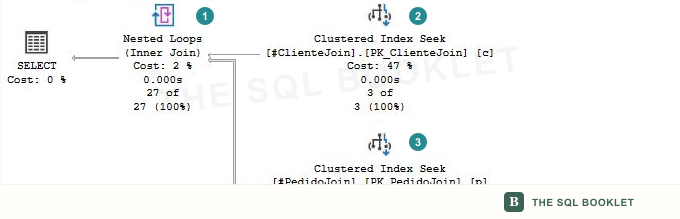
- 1Join operator
Nested Loopscoordinates the two branches and returns rows that satisfy the condition. - 2Outer input
The first
Clustered Index Seeksupplies the three customers that start the loops. - 3Inner input
The second
Clustered Index Seekfinds the orders associated with each customer it receives.
Query that produces the plan
The filter limits the outer input to three customers. INNER LOOP JOIN makes it possible to observe how each customer starts a search in the inner input.
SELECT
    c.IdCliente,
    c.Segmento,
    p.IdPedido,
    p.FechaPedido,
    p.Total
FROM #ClienteJoin AS c
INNER LOOP JOIN #PedidoJoin AS p
    ON p.IdCliente = c.IdCliente
WHERE c.IdCliente BETWEEN 1 AND 3
ORDER BY
    c.IdCliente,
    p.IdPedido
OPTION (RECOMPILE);
A small outer input and selective inner access can form an efficient combination. The same mechanism accumulates work when it receives many outer rows or each search reads more than expected.
In the plan, relate Actual Number of Rows on the outer input to Number of Executions on the inner branch. In the Key Lookup example, 90 locators produced 90 retrieval requests.
Hash Match
Hash Match gives its inputs different roles. The build input creates an in-memory hash table organized by the join key. Each row from the probe input then computes the same hash function and searches the group where its matches may exist.
- 1Build
Creates the hash table from one input.
- 2Probe
Consults that structure with rows from the other input.
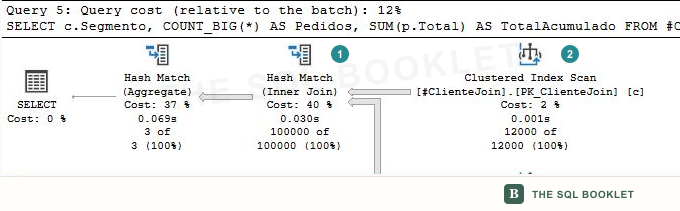
- 1Hash join
The relevant operator is
Hash Match (Inner Join). TheHash Match (Aggregate)to its left consumes the result for grouping and serves a different purpose. - 2One visible input
The
Clustered Index Scanreads one temporary table. Confirm each input's build or probe role in the properties; its position in the drawing is not enough to establish that role safely.
Query that produces the plan
This query processes the large sets without relying on an existing order. INNER HASH JOIN isolates the build and probe work of the hash table.
SELECT
    c.Segmento,
    COUNT_BIG(*) AS Pedidos,
    SUM(p.Total) AS TotalAcumulado
FROM #ClienteJoin AS c
INNER HASH JOIN #PedidoJoin AS p
    ON p.IdCliente = c.IdCliente
GROUP BY c.Segmento
OPTION (RECOMPILE);
This strategy does not require sorted inputs and can relate large sets through equality. It does require memory to build the hash table. If the grant is insufficient, part of the work can move to tempdb; that condition is verified through actual-plan properties and warnings, not from the name Hash Match alone.
The properties include Hash Keys Build and Hash Keys Probe. They identify the columns used to build and probe the hash table. Memory Grant, actual rows, and any spill warning complete the reading.
Merge Join
Merge Join receives both inputs sorted by their join keys. It compares the current values and advances through the input containing the lower value; when values match, it produces the corresponding rows.
- 1First sorted input
Advances through the join key without returning to the beginning.
- 2Second sorted input
Advances alongside it and supplies the matches.
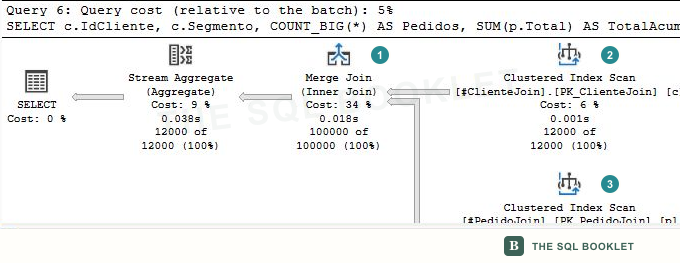
- 1Ordered join
Merge Join (Inner Join)compares the keys supplied by both branches. - 2First input
The
Clustered Index Scantraverses#ClienteJoinin clustered-index order. - 3Second input
The other
Clustered Index Scantraverses#PedidoJoinwith the same join key available in order.
Query that produces the plan
The clustered indexes supply both inputs ordered by IdCliente. INNER MERGE JOIN makes it possible to verify how the operator uses that order without adding a Sort.
SELECT
    c.IdCliente,
    c.Segmento,
    COUNT_BIG(*) AS Pedidos,
    SUM(p.Total) AS TotalAcumulado
FROM #ClienteJoin AS c
INNER MERGE JOIN #PedidoJoin AS p
    ON p.IdCliente = c.IdCliente
GROUP BY
    c.IdCliente,
    c.Segmento
OPTION (RECOMPILE);
The order may come from an index or a Sort operator. When it already exists, Merge Join can traverse large inputs continuously. When it must be produced solely for the join, the sorting cost and memory are also part of the strategy.
The Merge Columns properties show the keys used. The tree reveals whether the branches preserved useful order or a Sort appeared. A many-to-many merge can also require a worktable to handle duplicate values.
What to inspect in the plan
| Operator | Inspect first | Next question |
|---|---|---|
Nested Loops |
Outer rows and inner executions | Does repetition produce selective lookups or accumulated reads? |
Hash Match |
Build/probe inputs, memory, and warnings | Did the hash table stay in memory or spill? |
Merge Join |
Input order and Sort operators |
Did the order already exist, or did it have to be produced? |
Then compare estimated and actual rows. An inaccurate estimate can make a strategy look attractive during compilation even though it accumulates more work with the observed rows.
When the three checks are complete, remove the temporary tables or close the query window:
DROP TABLE IF EXISTS #PedidoJoin;
DROP TABLE IF EXISTS #ClienteJoin;
What this still does not establish
The operator alone does not prove that the query is optimized. Nested Loops can suit a few lookups and become costly when repeated; Hash Match can process large inputs in memory or spill; Merge Join can exploit ordered indexes or depend on additional sorts.
It is also unsafe to force an algorithm because it worked once. Volume, distribution, parameters, indexes, memory, and concurrency can change the lowest-cost alternative.